Monday, 27 February 2012

Player Comparison: Romario vs Ronaldo vs Rivaldo vs Ronaldinho vs Messi

From the early 90′s to the current team, Barcelona have relied heavily on the magic of their South American superstars. One club, two nationalities and five of the best players of all time. All won the World Player of the Year Award in their time with the Catalan club. But who performed most in the big games? And who was most important to the team? The fourth feature in the Player Comparison series compares those brilliant Barcelona boys – Romario, Ronaldo, Rivaldo, Ronaldinho and Messi.
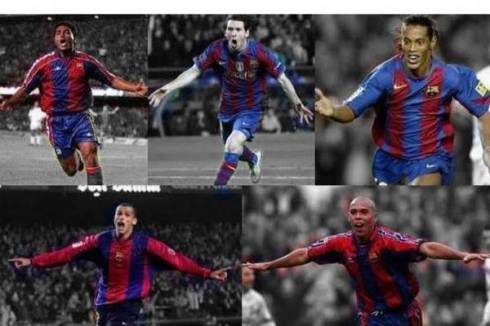

 
The Contenders:
 
First up is Romario, the Brazilian marksman was a ruthless finisher, and one of only two players to have scored 1,000 career goals – depending on what you class as official (more on that one here). He played in 6 different countries for 10 different teams, including footballing giants Adelaide United, Miami FC and Al-Sadd. For Brazil, he scored an incredible 55 goals in 70 games, winning the World Cup and the Copa America (twice). Described by Johan Cruyff as a “genius of the goal area”, he won La Liga and the Spanish Super Copa during his time his short stay at Barcelona.
 
Ronaldo came next. And it was an even shorter stay. For the single season that he represented Barcelona, there were absolutely no doubts who the best player in the World was. Although he didn’t win the League title with the Spanish Club, he did win the Copa del Rey and the UEFA Cup Winners Cup, and despite later going on to play for bitter rivals Madrid, he is still considered one of the Barca greats. Like his predecessor, he also won the Two Copa Americas and a World Cup with Brazil – and is the tournaments all time top scorer with 15 goals. In total he scored 62 goals in 98 appearances for Brazil. He suffered three career threatening injuries, with many suggesting that without them, he could have been the best of all time. Despite this, he still managed to win the World Player of Year award on three occasions.
 
After Ronaldo’s sale to Inter Milan, Rivaldo was identified as the player to fill the “Brilliant Brazilian” hole that had been left behind. More of a playmaker than the two before him, he was still a prolific scorer, particularly in his 5 years with Barcelona. Deadly from set pieces, he also had the eye for the spectacular – none more so than his hat trick to beat Valencia on the final day of the season to pip them to the last Champions League spot in 2001. The third goal was an over head kick from outside of the area in the last minute (as seen here), and possibly better than Pele’s in escape to Victory. He had a left foot like a magic wand/traction engine, and like Ronaldo, he enjoyed his greatest moment in the 2002 World Cup, as part of the 3 R’s attack. As appears to be the pre requisite, he also won the Copa America, and scored 34 goals in 74 appearances. He’s had even more clubs than Romario, and at 39, is still playing.
 
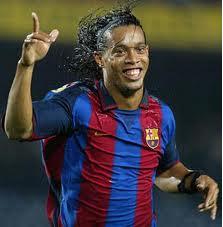
Fourth in the list, was cheeky schemer Ronaldinho. As with Rivaldo, he was also more of a playmaker, one blessed with incredible dribbling skills. He is one of the few Barcelona players to have received a standing ovation from fans of Real Madrid in the Bernebeu. Although mainly deployed from wide positions, he has close to 300 career goals (stop laughing Romario) including the 33 for his country (from 93 caps). At 31, he is still strutting his stuff in the Brazilian league with Flamengo. He’s regarded by some as a wasted talent, but during his time with Barcelona he won two World Player of the Year awards. Not bad for an International Playboy (I met him once in Las Vegas – the reputation is justified). Ronaldinho’s partying and the emergence of another skillful playmaker resulted in a somewhat premature exit from the Nou Camp, after he signed for AC Milan (like Rivaldo and Ronaldo before him). As with the players above, he also has World Cup and Copa America medals.
 
And so on to the last and current Barca player in our list – Lionel Messi. He has the vision of Rivaldo, the dribbling of Ronaldinho, and the finishing and pace of Romario and Ronaldo. He, like Ronaldo has 3 World Player of the Year titles. Where he differs from his Brazilian predecessors (apart from his nationality) is that he’s been a one club man. He had to overcome similar physical challenges as Rivaldo before making it as a top class player. The undoubted best player in the World at the moment, he just has to do it on the International stage to truly cement his place as one of the best, if not the very best of all time. He currently has 222 goals in 309 games for his club (as at the time of writing), and a rather more modest 19 in 66 for Argentina.
No hard feelings, I just want your Number 10″
 
Rules:
 
As per usual, it’s primarily a comparison of their Leauge goals rather than all goals. Why? Because it’s similar opposition (give or take for relegation) – and these opponents are ranked, meaning that we can calculate an average. As they played for different amounts of time for Barcelona, it’ll be a look at their most prolific season in the league. This is calculated on final league positions, rather than at the time of playing.
Of course these players aren’t just about goals, but I don’t have the assists available for Ronaldo and Romario, so will leave them out for this comparison.
 
Background:
 
Romario, then 27, signed in the summer of 1993 after 129 goals in just 5 seasons with PSV Eindhoven. Under the stewardship of Johan Cruyff, he had just one full season with the Spanish Giants, so we’ll be looking at the 1993-94 season.
 
Like Romario before him, Ronaldo made his European club bow with PSV, though only stayed for 2 seasons – his 54 goals in 57 games were enough to persuade Barca to part with $17m for a teenager. Under Bobby Robson, Ronaldo played just the one season with Barcelona – 1996-97.
 
Rivaldo joined aged 25, from La Liga rivals Deportivo La Coruna for a fee of $26m. Though he played for Barca for 5 seasons, it’s his most prolific that we’ll look at – 24 league goals in 1998-99. Free from the shackles placed upon him by Louis van Gaal in previous years, he thrived under Ferrer.
 
Ronaldinho’s most prolific season was actually after his two World Player of the Year awards. 2006-07 saw him bang in a decent 21 in the league in Frank Rijkaard’s penultimate season with the club.
 
And lastly, Messi’s best haul in La Liga was as a 22 year old. He looks set to have his best season in goal scoring terms this season, but for the purpose of this piece, we’ll use his prolific season under Pep Guardiola (Romario and Ronaldo’s team mate) in 2009-10. (this was written before his recored breaking 2011-12 season finished).
 
This was initially going to be about the 4 Brazilian’s, but you can’t leave Messi out of this. He fits the South American World Player of the Year criteria, and plays up top, so we’ll leave him in. Even though his name doesn’t begin with R and end with O.
 
 
Statistics:
 
Apologies for the long build up, but we can now move onto the stats. I’ve decided to look at it based on three criteria – goal scoring out right, big game players, and importance to the team.
 
Goalscoring:
 
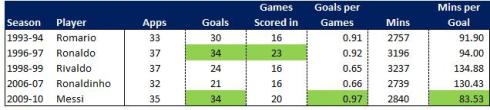
First up is the the goal scoring records of each player – based on goals per game and goals per minute:
 
 
Firstly, Ronaldinho’s 21 goals in 32 games would be an incredible season in most players careers, and a rate of 0.66 goals per game is an awesome strike rate. When you add to that the fact that he played wide of a front three, then it’s even more impressive. However, this comparison is against some of the greatest and most prolific forwards of all time. Whilst Ronaldinho is perhaps only second to Messi in the dribbling stakes, he’s last in the goals table. Similarly, Rivaldo was more than just a goal scorer, so 24 league goals is a great season.
 
To put it into perspective, it would have won the golden boot 4 of the seasons from 1997-2004.
And so onto the super strikers. In all honesty, there’s not much in it. Ronaldo and Messi lead the way in terms of goals scored with 34 (Messi in two games less). Romario wasn’t too far behind with 30 league goals from just 33 games.
 
They all have close to a goal a game strike rate with 0.91, 0.92 and 0.97 goals per game for Romario, Ronaldo and Messi respectively. To add some perspective, in the last 20 years only 3 other players have broken the 30 goal mark in a season – Cristiano Ronaldo last season, Diego Forlan the year before that, and Pizzi for Tenerife back in 1996. Pizzi did so in a 42 game season (he played 41 games), and whilst Ronaldo also did so in a 42 game season, he only played 37 games – within the confines of a normal season now. It’s interesting to see that the 30 goal mark has been broken in the last 3 (soon to be 4) seasons. Is La Liga getting easier?
 
When looking at the goals per minute, it’s Messi once again that does this business with a goal every 83.53 minutes. That works out better than a goal a game, and when allowing for injury time at the end of both halves of football – Ronaldo and Romario pretty much equal that with goals every 94 and 91.9 minutes. In terms of games scored in, Ronaldo walks this one, with a massive 23. It’s up to you the reader to decide if it’s better to score in more games, or to score multiple times in fewer games. Ronaldo can certainly say his goals influenced more games than the other players.
 
Winner: It’s a joint win for Ronaldo and Messi on this one. Messi equalled Ronaldo’s 34 in less games/minutes, but Ronaldo did it in more games. It’s also easy to argue that Messi’s team mates were better than Ronaldo’s. Honourable mention to Romario.
 
Big Game Players:
 
And so on to round 2, and the lifeblood of this site – who was most effective in the big games? Once again, unfortunately I don’t have the assists available for each player – so whilst they may have dominated the game without scoring (see Messi vs Real Madrid in 2010/11), we’re solely looking at goals.
 
 
Well well well. I didn’t just put it together like this so that Ronaldinho and Rivaldo could prevent it from turning into a 2 horse race. It’s certainly interesting that the two Playmakers have the best average ranked opposition per goal. Even though they scored the least amount of goals, they had the mentality to perform in the big games – more so than the small games. They’re the only two on the list that have more goals against the Top 6 than the Bottom 6. It was certainly levelled at Ronaldinho that he didn’t always turn up for the small games (mentally not physically) – and this goes some way to proving it.
 
Big game? That’ll be Real Madrid. Interestingly, all 5 players scored against arch rivals Real Madrid in their Barca careers, though Ronaldinho didn’t manage it in his most prolific season (a young Messi did though). Romario banged in a hat trick in a 5-0 whitewash, Ronaldo scored the winner in a 1-0 win whilst chasing the Madrid club for the title, Rivaldo scored in a 3-0 win, and Messi scored in a 2-0 win at the Berbebeu.
Although Ronaldinho didn’t have the goal against Madrid, he did score against the teams in 3rd, 4th, 5th, 6th and 7th. And this was a league table where 3rd placed Sevilla were only 5 points off the title, rather than the 24 points that Valencia are behind in today’s table.
 
Messi has the most goals against Top 6 opposition with 10, but this was in a league where 3rd placed Valencia finished 28 points behind the Champions, and 6th placed Getafe were 41 points off Top spot – whilst only 22 off relegation. The gap between 1st and 6th was only 16 points in Ronaldinho’s 2006-07 season – the lowest by someway – adding to the importance of Top 6 goals.
 
Ronaldo and Romario fall victim to being consistent with an expected split weighted towards the middle range, and it’s worth noting that Ronaldo’s goals against the Top 6 opposition were worth more points (6) than any of the others.
 
Winner:Although his star had started to fade, it was Ronaldinho’s big game mentality that shone through. He scored twice the amount of goals against Top 6 as he did against Bottom 6, had the best Average ranked opposition for each goal, and the league he played in was still very very competitive. The only he didn’t notch against Real, he did against all the other challengers.
 
 
Importance to team – goals as points:
 
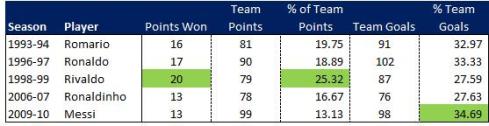
The last measure is based on the importance of the goals. It’s not an exact science but it does give a basis to measure the importance of a goal. For the mathematics behind it, click on the Rules and Workings page. So if we take Romario’s hat trick against Real Madrid as an example, he’d receive zero points for his treble as the team won 5-0. If you take his goals away, then they’d still win 2-0. Similarly, Rivaldo’s hat trick against Valencia in 2001 was worth all 3 points as they were the only Barca goals in a 3-2 win. Take them out and the team lose 0-2. So with that in mind:
 
 
Despite scoring less goals than Romario, Ronaldo and Ronaldinho, it’s Rivaldo who’s goals were most important to his team. His 24 goals were woth a massive 20 points to Barcelona’s final tally of 79. This means that he also leads the way in the percentage of team points he was responsible for, with a mightily impressive 25.32. Barcelona went on to win the title that year and usually you’d expect the Champions points spread quite wide across a team. It’s not unusual to see a struggling team have a stand out player for points, as the team points is that much lower, so to score goals worth a quarter of the final tally is very impressive.

Ronaldo once again is there are there abouts. His 34 league goals were worth 17 points as Bobby Robson’s team just missed out on the title by 2 points to Real Madrid. If he’d played all the games, it’s likely that he would have made the difference. He edges out his predecessor Romario who had a credible 16 points.

Surprisingly enough, Messi and Ronaldinho’s goals were only worth 13 points – 13.13% and 16.67% of the the over all points tally.
 
Although they were less important that the other players, Messi is ahead on the percentage of the team goals scored with 34.69% – narrowly ahead of Ronaldo and Romario.
 
Winner:This one has to go to Rivaldo. Whilst he scored less goals than than 3 of the other contendors, the goals he did score were worth more to his team. Honourable mention to Ronaldo who won 17 points, and scored a third of his teams goals.
 
Overall Winner:
 
With wins for each player (aside from Romario) across the three categories, it’s incredibly hard to call this one. Each reader will have their own opinion as to which parameter is most important. Some may well argue that stats don’t tell the whole story – and i’d agree to an extent, as there is no measurement on assists, on brilliance, beauty, style etc…..Personally, Ronaldo is my favourite footballer of all time, regardless of the stats, but regular readers will no that I don’t like to sit on the fence, nor let my preconceptions shape the outcome.
As a result, I decided to rank the players on each measurement and work out the average position. And so, without further ado, I give you:


Overall Winner:
 
 
Well it looks like Messi has done it again. Taking into account every single parameter, he just edges out Ronaldo with a average rank of 2.4 across the 10 measurements, with Ronaldo averaging 2.5. It’s no surprise that the order is the same as the number of goals scored.
 
Whilst he appears set to be crowned Barcelona’s all time greatest player – and 3 Champions League titles of their 4 would suggest it’s justified, it’s worth noting that Ronaldo’s 34 league goals (and 47 overall) came when he was just 19 years old. Messi’s season at 19 read played 26, scored 14 (17 in 36 overall). So whilst Messi is the winner here, i’d stick my neck out and say that had Ronaldo stayed at Barcelona, and avoided injuries, then he would have won.
 
Interestingly, if you remove the percentage of team goals statistic, then Messi and Ronaldo are level.
 
In Conclusion:
 
All five players were among the best of their generation, and arguably of all time. It’s a shame that Romario and Ronaldo’s stay was so short as they both had their best seasons with the club, and it meant that the comparison was restricted to just one season per player.
 
Whilst Messi tops the league in this comparison, he still falls short on the international stage. The four Brazilians have World Cup and Copa America glory, and until Messi wins big and performs well on the biggest stage, there will still be some doubting his place on the football pantheon, alongside Pele, Maradona and Zidane. I would also put Ronaldo on that list. He’s the all time top scorer in the World Cup, he’s the three time World Player of the year, and he had to overcome three career threatening injuries resulting in having to change his game. A good piece of trivia is that he is the only player to have scored on both sides of the Clasico and the Milan derbies. Ronaldo aged 17-21 is one of the greatest players of all time, and better than Messi at the same age.
 
Luckily for Messi, there were no measurements based on partying.
 
Further Viewing:
 
Enjoy:
 
Ronaldo 1996/97 Top 10 (The top 3 are ridiculous)
 
Apologies for the length of this one, but with five players (and five of the all time best), it’s hard to keep the word count down. Make up your own mind who you think was best for Barca. The stats say Messi, my own personal choice is Ronaldo, but it differs for everyone. I hope you enjoyed the latest Player Comparison, and as always, all suggestions are welcome. Whether you want an in depth anaysis, or are just wondering about the stats of a few players to settle a pub argument.
 
Cheers,
 
Liam

Friday, 27 January 2012

Player Comparison: Thierry Henry vs Ruud van Nistelrooy

Hot on the heels of the Lampard vs Gerrard comparison, the third in the series is another of the Premier League’s most discussed duos – Thierry Henry and Ruud van Nistelrooy. For the 5 years, that they both played in the Premier League they dominated the goalscoring charts with five winners, three runners up and one 3rd place in the race for the golden boot. But who was the bigger game player?


Henry getting away with another blatant handball


The Contenders:
 
France and Arsenal’s all time leading scorer, the man who brought va va voom to the Premier League and who is one of the most unpopular players in Ireland, Thierry Henry. Signed from Juventus after a less than convincing spell, Henry won 2 league titles and 3 FA Cups with the Gunners before moving on to Barcelona. On the Oranje side is Holland and Man United’s Ruud van Nistelrooy. Ruud has top scored in the Champions League 3 times, as well as golden boots in the Dutch, English and Spanish league. He moved on to Real Madrid in 2006 after winning 1 Premier League title, an FA Cup and a League Cup.
 
The Background:
 

Henry at Monaco
 
Henry began his football career at Monaco under the tutelage of his future Arsenal manager Arsene Wenger. Initially played on the wing, he was eventually moved up front. He made his professional debut in August 1994 – going on to make 141 appearances for Monaco and scoring 28 goals in all competitions. He made his France debut in 1998 and went on to win the World Cup that same year, and earning a big move to Juventus. Henry struggled to make an impact with the Old Lady (I wonder would Wayne Rooney thrive there?) and found himself back out on the wing. After 3 goals in 19 appearances, Henry was reunited with his first manager in North London. It’s fair to say his strike rate improved with 46 goals in his first 100 games for the Gunners – taking us up to the summer of 2001.
 
Ruud van Nistelrooy had to overcome several hurdles at PSV
 
Ruud van Nistelrooy’s early career wasn’t quite as glamorous. He started his professional career with Dutch minnows Den Bosch. Like his French rival, he also started out as a midfielder but was moved to centre forward early on. He made his debut in 1993 and went on to score 20 goals in 71 appearances for them. His form in 1996-97 caught the eye of Heerenveen who shelled out €360k on the Dutch thoroughbred. His stay with them was a short one – his goalscoring record secured a move to Dutch giants PSV Eindhoven (for €6.3m – a tidy profit). It was here that his career really took off, scoring an impressive 71 goals in 95 games for the Eindhoven club. A move to Manchester United was all but tied up in 2000, but a serious knee ligament injury delayed it for a year.
 
The Rules:
 
As per usual, it’s primarily a comparison of their Premier Leauge goals rather than all goals. Why? Because they played against the same opposition over the same time period – and these opponents are ranked, meaning that we can calculate an average. International goals will also be taken into account. The time scale is the 5 year period from 2001-2006, from when van Nistelrooy joined, to when he left.

Premier League:
 
2001-2002:
 
And so on to the stats, their first season head to head was Henry’s 3rd in the league, and van Nistelrooy’s first. With that in mind, it’s particularly impressive the impact that the Dutchman had, and just how close he ran Henry for the Golden Boot. Henry played one game more and scored 24 goals to van Nistelrooy’s 23. Their goals per games tally were virtually identical – 0.73 vs 0.72. Who did it in the big games?
 
 
Well once again it was very close. Henry scored 4 against Top 6 opponents on his way to winning the league title with Arsenal. Chelsea (6th), Man Utd (3rd, two goals) and Liverpool (2nd) were all victims to his goalscoring touch. On the other side, van Nistelrooy scored in both games against 4th placed Newcastle, and once against Chelsea. From an average opposition point of view, the Dutchman edges it with an average opponent per goal of 12th place compared to Henry’s 12.25.
 
Winner: A Draw
Too tight to call this one, so a draw. An incredible debut season for Ruud, whilst Thierry stepped up to score over 20 league goals for the first time in his career. Henry had 4 against the Top 6 (one pen), whilst van Nistelrooy had a better average. This is just based on goals scored – Henry provided more assists by far, but this comparison is just on the goals….for now.
 
van Nistelrooy’s only title came in 2003

2002-2003:
 
Round 2, and after Arsenal won the title in 2001-02, Man Utd were out for revenge. And revenge they found. Powered by van Nistelrooy’s goals, United won the Championship, in what would be the Dutchman’s only Premier League title.Once again, they were pretty much neck and neck in terms of goals scored, this time van Nistelrooy winning the Golden Boot by one goal. He did it in 3 games less, taking his goals per game to an impressive 0.74 to Henry’s 0.65.
 
 
And they’re not the only stats that he wins on. His Average Opposition Index (AOI) was a very impressive 9.28, compared to the French hitman’s 12.25. The driver behind the AOI was a whopping 8 goals vs Top 6 opposition. On their way to the title, van Nistelrooy scored against 3rd placed Newcastle (4 goals including a hat trick in a 5-3 win), Blackburn Rovers (6th), Liverpool (2 goals) and most importantly, against title rivals Arsenal. In comparison, Henry scored 5 goals against the Top 6 teams, including both goals against United in a 2-2 draw.
 
Winner: Ruud van Nistelrooy
Although the number of goals were once again similar, the AOI and goals against Top 6 were heavily weighted in his favour.
 

RVN showing customary calm under pressure. From a nutter.

2003-2004:
 
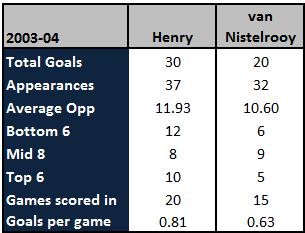
In what was an historic season, Arsenal would once again take the crown of Premier League Champions from United but this time would go the whole season unbeaten. Not only was this Arsenal’s greatest season, it was also Henry’s best in the League with 30 in 37 (0.81 goals per game). Ruud van Nistelrooy hit 20 league goals for the 3rd season running, but was way behind his rival.
Once again, it was the Dutchman who had the best AOI rating with 10.6 compared to Henry’s 11.93 but that was the only area he bettered Henry who smashed in 10 goals against the Top 6 (in a maximum of 10 games). Once again for the 3rd season running, he scored against United, this time in a 1-1 draw, whilst the highlight was a Hat trick against Liverpool in a game where his team was behind twice.
 
Winner: Thierry Henry
Ahead in goals and against Top 6 opponents. Inspired his team to go the season unbeaten on the way to winning the league. Sadly for Arsenal fans, their last at the time of writing. Ironically, van Nistelrooy could have ended the unbeaten streak, but missed a penalty in a 0-0 draw – much to Martin Keown’s delight.

Henry carried Arsenal to the title in 2003-04

2004-2005:
 
And so after 7 years of what seemed like Man Utd vs Arsenal for the title, Chelsea and Mourinho took over. In terms of the Player Comparison, this season was a write off for van Nistelrooy, with injury and form going against him. Just 6 goals, 3 of which were penalties, were scored in his 17 League appearances. On the other hand, Henry continued his impressive form with a 4th straight season of 20+ goals – hitting 25 in 32.
Not really much in way of comparison here, although interestingly, despite playing almost double the games, Henry only scored 1 more against the Top 6. Two of the three goals were against the Champions Chelsea in a 2-2 draw. Undeniably a big game.
 
Winner: Thierry Henry
For the first time, Henry’s AOI rating was better than the Dutchman’s, along with every other stat. No comparison. If the Dutchman were a horse, he’d have been put down.

2005-2006:
 
And so onto the final season in the comparison, and van Nistelrooy’s final in England. Chelsea once again went on to claim the title, but Henry won the Golden Boot for the 3rd season running. But what of the comparison, and the big game scoring?
It was certainly a return to form for van Nistelrooy after a poor 2004-05. However, once again he was just no match for his French rival. Henry outscored in both goals and goals per game, had a better AOI rating (although still below the 10.5 aim), and did it more often in the big games vs the Top 6. In this season, he scored against 3rd, 4th, 5th and 6th, whereas van Nistelrooy only scored against 6th placed Blackburn Rovers.
 
Winner: Thierry Henry
The stats do tell the full story on this occasion.

Premier League Conclusion:

Just looking at the Premier League goals, it’s a 3-1 win to Henry in the 5 seasons.
 
He’s done it against Top 6 opposition on more occasions, with 28 goals to 21 and has 0.76 goals per game vs 0.63. However, food for thought is that van Nistelrooy’s split is as you’d expect – 23-51-21 which converts to 24% of his goals were against Bottom 6, 54% vs Middle 8 Opponents and 22% vs the Top 6 teams. Henry’s split isn’t as consistent at 34%-44%-22%.
 
International Goals:
 
 
From the off, you look at Henry’s International career and see a World Cup medal, a European Championships medal and a Confederations cup medal. In terms of strike rate, he has 51 goals in 123 games (0.41 goals per game) and is France’s record scorer – over taking Platini’s haul. By comparison, van Nistelrooy has a better strike rate with 35 goals in 70 games (0.5 goals per game).
 
Of those goals, Henry has 6 World Cup goals and 6 European Championship goals. For Holland, Ruud has 1 World Cup goal, but matches the tally of 6 in the European Championships. And so once again onto the stats:

Once again, it’s a win for Thierry – he has more goals, a better AOI of 50.98 vs van Nistelrooy’s 61.11 and is ahead on Top 10 opposition goals. Whilst he didn’t score in the two biggest international games of his career – World Cup final 2006 and European Champonships Final 2004, he has done it against big teams. Goals against Portugal, Germany, Brazil, Italy and Holland points to the fact that he can do it against the best, indeed the winner vs Brazil in the 2006 quarter finals is undoubtedly a big game goal.

For Holland, van Nistelrooy has a disappointing 3 goals versus the upper echelons of Footballing nations. His best moments for Holland came in Euro 2004 when he scored 4 goals – against Germany, Czech Republic and a brace against Latvia.
 
Both have a good International record and Henry’s medals would point to a great record. However, neither have really done it in the biggest games, something that separates the likes of Henry and van Nistelrooy to Brazil’s Ronaldo. Not many strikers have really done it in World Cup finals of late – Iniesta settled 2010, Materazzi and Zidane scored in 2006, and it was Zidane again with fellow midfielder Petit that settled the 1998 World Cup. Before that it was penalties in 1994 and a penalty by defender Brehme in 1990.
 
For Further Consideration

When looking at their big game credentials, it’s worth taking into account a few more details that aren’t easily comparable as the opponents aren’t ranked, and differ. In the Champions League, Henry has a medal with Barcelona, but again, failed to score in both the 2009 final, and the defeat for Arsenal in 2006. Ruud van Nistelrooy has 3 top scorer awards in the competition, and is second only to Raul in the all time European Cup scorers list. Guess who’s in 3rd? Thierry Henry of course.
 
In terms of cup finals as a measure of big games, van Nistelrooy scored twice in the 2004 FA Cup final – although as a caveat, this was against Championship side Millwall. He also played in the 2005 final versus an Henry-less Arsenal, the game finished 0-0. He also failed to score in the 2004 League Cup final defeat to Liverpool.
 
In terms of importance to their teams and value added to them, the below once again has Henry on top. Even taking into account van Nistelrooy’s poor 2004-05, Henry still wins in points gained and percentage of team points earned.
 
In Conclusion:
 
The whole point of these player comparison’s is to find who was the better player from a big game perspective by looking at the opposition. In that sense, Thierry Henry wins. He does it more often against the Top 6, which is the measure to track by. Ruud van Nistelrooy edges it on the Average Opponent per goal rating, but that’s because Henry also heavily punished the Bottom 6. He has more tournament goals than his Dutch rival as well – another measure of a big game player.
 
Ruud van Nistelrooy has undoubtedly been a great goalscorer, and perhaps to say he isn’t a big game player is harsh as he hasn’t had as many final appearances as Henry. He still had 21 goals versus Top 6 opponents – which is still one of the best records of recent years. To van Nistelrooy’s credit, there wasn’t much in it against a player twice in the Top 3 for the World’s best.
 
So well done Thierry, he proved that beautiful football could win over a ruthless finisher. Although comparing the two, they are different types of players, and it’s worth remembering that in those 5 seasons, Henry also provided 59 Premier League assists.

BUT.

He may rate as a big game player in the Premier League, and indeed he had his moments in Europe – a hat trick at Roma, a brace in the San Siro and the winner against Real Madrid showed this, however, no goals from the below games unfortunately excludes him from joining the greats:
  • 2001 FA Cup Final
  • 2002 FA Cup Final
  • 2003 FA Cup Final
  • 2000 UEFA Cup Final
  • 2006 Champions League Final
  • 2009 Champions League Final
  • 2000 European Championships Final
  • 2006 World Cup Final.
Personally, I think he’s one of the best players I’ve ever seen, it’s just a shame he never did it on the biggest stages.
 
Thanks for reading, it’s a bit of a long one, but when looking at two such decorated players, it was hard to cut it down. You’ve seen the stats and facts, make up your own mind.
 
If you’ve any ideas for the next Player Comparison, leave a comment or send me a mail.

Cheers,

Liam

Sunday, 15 January 2012

Player Comparison: Steven Gerrard vs Frank Lampard

After starting the Player Comparison series with the two best players in the world, how do you follow that? In terms of quality of player, you can’t (unless I had the Pele/Maradonna stats handy). But the idea behind this series was to not only look at two comparable players based on stats, but also to help settle pub debates. And so with that in mind, and from a Premier League starting point the contenders choose themselves. Fewer players have been at the heart of debates and comparisons, both for rival club fans, but also for England fans.

Piggy back football never really took off
 
The Contenders:
 
In the Red corner, we have Liverpool’s home grown King of the Kop, Stevie G. Gerrard has been strutting his stuff at Anfield since 1998, and for the national team since 2000. In the Blue corner, we have his Southern counterpart, JT’s BFF, Frank Lampard. Whilst Gerrard has only known life at a big club, Lampard began his football education at West Ham’s prolific youth academy. Under the tutelage of Tony Carr and then Uncle Harry, young Frank made his debut in the 1995-96 season (first on loan at Swansea) before eventually moving on to current club Chelsea in the summer of 2001 for what at the time seemed an excessive £11m but in hindsight, was something of a bargain. He made his England debut in 1999.

The Background:

Lampard is 2 years older than his Mersey rival and has been on fans radars that bit longer. Having always been an attacking central midfielder, he perhaps had a head start on Gerrard in terms of goals scoring. Those of you who can remember far enough, will recall that Gerrard initially broke into the England team as the deeper lying defensive midfielder next to the attacking Paul Scholes. It appeared as though Lampard was being groomed to play the attacking role from the middle, whilst Scholes was pushed out left. However, by this point Gerrard had started to display his attacking instincts, rather than being the holding player he first appeared. The result being a headache for their national coach for the best part of a decade. Gerrard’s been pushed forward, Lampard back, Gerrard wide, and Lampard as part of a diamond. Yet still, England have never really performed with the two players in tandem. 

 National team aside, there’s also been their club form, with both known throughout the World as two of the best goal scoring midfielders in football. Add to that a bit of bad blood between the clubs and Gerrard’s aborted move to Chelsea, and you have a debate on your hands. Who is or was better?

Rules:

As with the Messi vs Ronaldo comparison, I’ll be comparing their league form as there are no rankings applied to the Champions League. The comparison will begin from the 2001-02 season when Lampard began his Chelsea career. I’ll also review their international goals as well. Unlike the Ronaldo v Messi comparison, this will be based on final league positions.

Premier League:

And so onto the Stats. At first glance, and much to my surprise, there’s actually no comparison at all. In the ten and a half seasons since Lampard joined Chelsea, he’s scored 123 league goals in 362 games to Gerrard’s 78 in 320. That’s a rate of 0.34 per game compared to 0.24 or on the other hand, a goal every 3 games for Lampard aginst one every 4 games for Gerrard. Case closed.

 
All Hail Frank Lampard – king of the goalscoring midfielders. He’s got more goals, more assists, and more against the Top 6 with a very impressive 24 goals compared to Gerrard’s 14. And he can be relied on to play more games each season. Gerrard only comes out on top in terms of Average Opposition. On average, across the 10 and a half season, his goals are against 11.82 ranked opponents, compared to Lampards 12.39.

Well, that didn’t take long at all, I should probably start on the Henry vs van Nistelrooy comparison.
But wait. Scratch a little under the surface and things are indeed a little closer, and worth a comparison. Since Zola left Chelsea at the end of the 2002-03 season, Lampard has been taking his teams penalties, and he’s scored 33 of them. Take the penalties out and he’s on 90 goals. In that same time, Gerrard has scored 12 penalties, taking his goal tally down to 66. Now 90 vs 66 is still a decent gap, but if we took Gerrard’s goalscoring rate and applied it to 362 appearances, he’d be on for 75 goals.


Lampard is still on top, but once you take away the penalties, the goals per game is now just 0.25 to 0.21. Gerrard is still doing it against better opposition as well – his Average Opposition Index is 12.29 compared to Lampard’s 12.80. The most telling numbers though are in the goals against Top 6 Opposition. With penalties removed, Lampard loses almost half of his goals against the top ranked opponents. It’s now only 11 goals vs Gerrard’s 10 goals – and this is essentially in a season more of appearances – 42 extra.

So from a big game player point of view, the stats are now leaning towards Gerrard. What must also be taken into account is the teams that they play in. Since 2001, Chelsea have won the title 3 times and finished 2nd a further 4 times. Their average position over the 10 full seasons is 2nd. In the same period, Liverpool have finished 2nd twice, but more tellingly, have finished outside the Champions League Top 4 spots in four seasons. Their average position is 4th. Even the most die hard Liverpool fan would have to admit that Chelsea have consistently had better players. Goal scoring opportunities, and indeed assists are largely dependent on team mates.


Looking at the above graph, both players best goalscoring seasons have coincided with the team’s highest finish. In 2008-09, Gerrard scored 16 league goals (12 after penalties) in the season that they’ve come closest to winning the Premier League, finishing the season on 86 points. Lampard meanwhile scored an incredible 22 goals in 2009-10 (13 after penalties) to end Manchester United’s 3 year spell of dominance. This would suggest each player’s goals were significant to the club’s final positions.

 
It’s not an exact science, but if you take out the goals scored by each player, Chelsea would be worse of by an average of 3.5 points per season, whereas Gerrard’s equivalent contribution is 3.6. Nothing in it. But what about the percentage of the overall team points – to allow for the quality of the teams. Well once again, it’s very close. Lampard’s goals are directly responsible for 4.33% per season of Chelsea’s points over the last 10 seasons. Gerrard’s goals are worth 5.33% of Liverpool’s total points per season. On this measure, Gerrard is more important to his team. For the record, with penalties, Lampard’s percentage increases to 7.33% compared to Gerrard’s 6.02%.

What this parameter doesn’t take into account is the order of the goal. As mentioned in the last Premier League update, “you could for example take Chelsea’s 3-1 win over Norwich earlier in the season. As Chelsea won by two goals and had three different goal scorers, take one of Bosingwa’s, Lampard’s or Mata’s goals away and the result would still be 2-1 to Chelsea – meaning that there is no direct impact to the result and number of points. In reality – the opening goal of a game is always important (Bosingwa), and Frank Lampard’s goal in that match was in the 84th minute, which put Chelsea back ahead. Both were important goals, but due to Mata’s injury time goal – the importance in this formula lessens.”

With this in mind, what’s the average order of their goals? We know that the first goal is always the most important for a team, whilst the second can often prove decisive. For Chelsea, for both his 123 league goals, and the 90 from open play, Lampard on average, scores Chelsea’s 2.1 goal. In the same period, Gerrard’s 78 league goals have come as Liverpool’s 1.9 goal, compared to 1.8 after penalties are removed.

So all in all, looking at all of the stats based on their goalscoring, the average and range of the opponent, and the importance to their teams, there’s very little to choose between them. Lampard has more goals, Gerrard has a better opponent per goal. Lampard has more assists, but Gerrard is more important to his team. I hate to sit on the fence, and generally dislike to do so, but there’s nothing in it.

Internationals:

The lads enjoying another high point with England
 
But what of their contributions to the national team. After all, the biggest talking point around the players is why can’t they play together? Well as we’ve seen above, they’re just too similar. Sir Alf Ramsey famously didn’t choose the best players in every position to win the World Cup back in 66. He played the players that gave the best balance – a balance that’s missing when they’ve played together in the middle. We know that Gerrard is likely to be pushed further forward or even out wide if both players make the starting line up in the upcoming European Championships, but who deserves the attacking central midfield slot?


I’m afraid it’s not much clearer at International level either. They’ve both played pretty much the same amount of games for England, and in that time, Lampard leads the goal count with 23 to 19. However, once penalties are removed, Gerrard has actually scored 19 to Lampard’s 16.

Both have scored against good opposition – Gerrard’s first goal was in the 5-1 win away at Germany in the 2002 World Cup qualifying game. Lampard can count goals against number 1 ranked France (Euro 2004) and Spain in his tally. Of their goals, 7 of Lampard’s have been in friendlies, compared to Gerrard’s 5. The average opposition index leans in Lampard’s favour by 14 places, which would suggest he is the bigger game player for England. Indeed, he was voted England’s player of the year after his 3 goal haul in Euro 2004. The Elephant in the room though is the World Cup. Gerrard has scored 3 goals in the two World Cup’s he’s played in whereas Lampard has received criticism (particularly in 2006) for failing to do so, despite many many shots. He can count himself unlucky that his excellent chip against Germany in the last World Cup was incorrectly disallowed.

So looking at the Internationl records, we’re still in the dark. Lampard has the better Average Opposition, but more goals are in Friendlies, and he takes the penalties. He did have a great European Championships, but Gerrard has scored in 2 World Cups, and has more goals in open play – despite starting off in the holding role.

In Conclusion:

In terms of who’s the better player for the big games, I’m afraid it’s just too close to call. Both players have scored in Champions League finals. Both have scored decisive goals in FA Cup finals. Gerrard has also scored in the League Final and the UEFA Cup Final, whilst Lampard has scored the goals to win Chelsea the title. Both have scored 4 league goals vs perennial title winners Manchester United. Both are big game players. Lampard has 22 European Goals in 89 games (including 4 with West Ham), Gerrard has 38 in 116. Gerrard is more important to his team, whereas Lampard does it more consistantly, albeit against slightly lower opposition.

Looking strictly at the stats, it’s impossible to call this one, and despite hating sitting on the fence, this one will have to be left up to each reader’s interpretation. What can be agreed on by all, is that they are both outstanding players, and will go down as two of the Premier League and indeed European Football’s best goalscoring midfielders.

Any comparisons you’d like to see, please let me know.

Cheers,

Liam

Note: Stats were correct up to January 13th 2012